
Can International Students Attend Calvary Chapel Bible College in the United States?
A History of Welcoming Students from Around the World
Throughout its history, Calvary Chapel Bible College has welcomed students residing in more than 50 countries and territories.
Students represented in CCBC’s historical records have come from:
- North America and the Caribbean
- Latin America
- Europe
- Africa
- Asia
- The Middle East
- Oceania
Countries especially represented include Canada, the United Kingdom, Mexico, Australia, Japan, South Korea, Germany, Singapore, Belize, and Spain.
Because CCBC’s historical records are expansive but may not include every student who attended, these figures should be understood as a documented picture of the college’s international reach rather than a definitive all-time count. They also reflect CCBC’s broader history, not only current enrollment at the Florida campus.
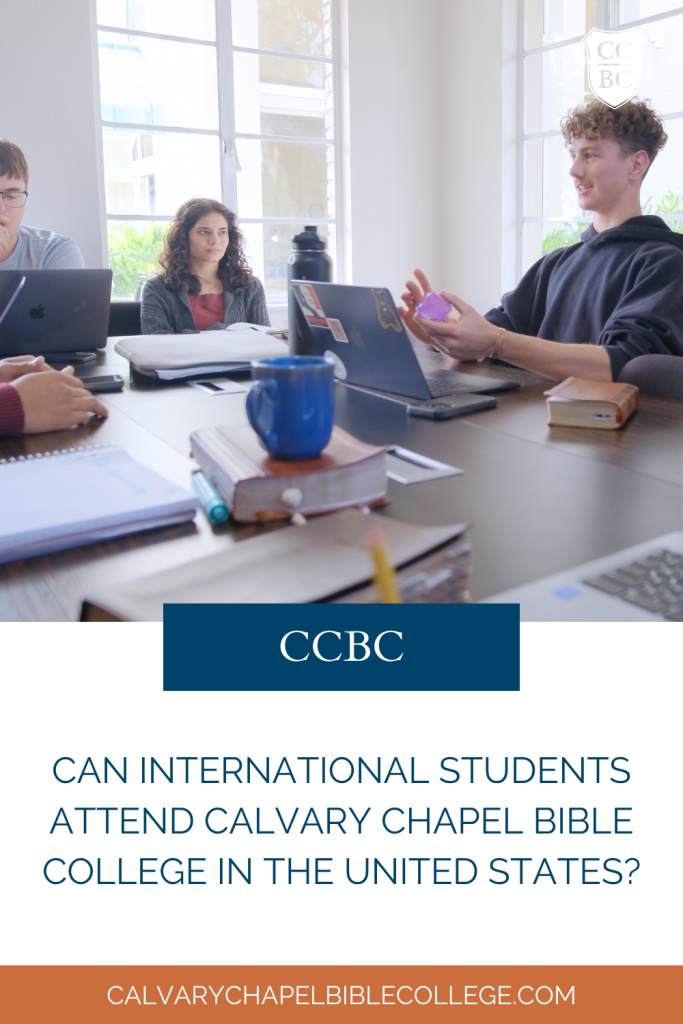
Students have come from many nations and Christian contexts, but they have shared a desire to know God and understand His Word. At CCBC, the Bible is our primary textbook. We invite students to study the Bible like it matters and build a biblical foundation for every calling.
How Does an International Student Apply to Calvary Chapel Bible College?
The international application process generally includes the following steps:
- Submit an application to CCBC.
- Provide the required academic records and pastoral reference.
- Complete the required foreign-credential evaluation.
- Demonstrate English proficiency when required.
- Receive an admission decision from CCBC.
- Submit documentation showing sufficient financial resources.
- Receive Form I-20 after satisfying the applicable requirements.
- Pay the required SEVIS fee and apply for an F-1 student visa.
- Prepare for travel after the visa is approved.
- After arriving in the United States, complete CCBC’s international-student check-in with the DSO so that enrollment and SEVIS registration can be completed.
Students should begin this process early. Credential evaluations, financial documents, visa appointments, and government processing can take time.
Applicants should not purchase airline tickets or make final travel arrangements until their visa has been issued. An admission decision or Form I-20 does not guarantee visa approval.
What Academic Records Do International Applicants Need?
International applicants must provide evidence that they are academically prepared for college-level study.
CCBC’s general application requirements include:
- Proof of high-school completion or its equivalent
- Official academic transcripts
- A pastoral reference
- Any additional materials required for international applicants
As part of CCBC’s international admissions requirements, international applicants who completed secondary or postsecondary education outside the United States must submit an evaluation of their foreign credentials from a NACES-approved evaluation service. This requirement applies to both high-school and college-level records.
Any documents not written in English must also be accompanied by a certified English translation. Applicants with previous college experience should request a course-by-course evaluation so CCBC can determine whether any completed coursework may be accepted for transfer.
Because processing can take time, applicants should begin the evaluation process early and contact CCBC to confirm which evaluation services and documents are accepted.
Do International Students Have to Take the TOEFL?
How Much Financial Support Must an International Student Demonstrate?
Before CCBC can issue Form I-20, an international student must document sufficient financial resources to cover the estimated educational and living expenses for the academic period shown on Form I-20. For most students, this represents approximately one academic year. CCBC will provide each applicant with the current amount that must be documented.
Current school-billed costs for an on-campus student are estimated as follows:
| Educational Expense | Estimated Academic-Year Cost |
| Tuition | $9,000 |
| Room and Board | $6,000 |
| Administrative Fees | $200 |
| Base Annual Total | $15,200 |
- Health insurance
- Books and course materials
- Personal expenses
- Transportation
- Travel to and from the United States
- Visa and SEVIS-related fees
- Emergency or unexpected expenses
What Is Form I-20?
Form I-20 is the Certificate of Eligibility for Nonimmigrant Student Status.
After CCBC has accepted an applicant for a full course of study and verified the information and documentation required for I-20 issuance, a CCBC designated school official creates the student’s SEVIS record and issues Form I-20.
The basic visa process is:
- CCBC’s designated school official issues Form I-20.
- The student reviews and signs Form I-20 and pays the I-901 SEVIS fee.
- The student completes and submits Form DS-160.
- The student follows the instructions of the appropriate U.S. embassy or consulate, including paying any required visa-application fee and scheduling an interview when required.
- The student attends the visa interview, if required.
- A U.S. consular officer makes the visa decision.
The exact order and requirements can vary by embassy or consulate, so applicants should follow the current instructions for the location where they will apply.
Receiving Form I-20 does not mean that a visa has been granted. The U.S. government—not CCBC—makes the visa decision.
The U.S. Department of State explains that applicants may be asked to provide evidence of their academic preparation, intent to leave the United States after completing their studies, and ability to pay educational, living, and travel expenses. Applicants should consult the official U.S. student visa guidance and the instructions of the U.S. embassy or consulate where they will apply.
Can International Students Receive CCBC Scholarships?
International students may be eligible for CCBC scholarships when they meet the applicable requirements.
One available opportunity is the Church Match Scholarship. Under the current policy, a student’s home church may contribute toward tuition, and CCBC may match that contribution up to one-third of the semester’s tuition, subject to the scholarship’s requirements and available funding.
Scholarship availability can change, and awards should not be assumed when documenting the resources needed for Form I-20. Applicants should speak with CCBC about:
- Current scholarship opportunities
- Church Match Scholarship eligibility
- Payment-plan options
- Scholarship application deadlines
- How confirmed awards affect required financial documentation
International students should not plan to finance their education primarily through employment in the United States. Employment for F-1 students is restricted and requires compliance with federal rules and, in some cases, advance authorization.
What Is It Like to Study at CCBC in Florida as an International Student?
International students who attend CCBC on campus join a residential Christian learning community in Bradenton, Florida.
The experience includes more than attending classes. Students study Scripture, participate in worship and prayer, share daily life with other believers, serve in the local church, and develop relationships with classmates from different backgrounds.
Both the Associate and Bachelor of Biblical Studies programs are designed around the study of Scripture. Students engage biblical books, theology, church history, ministry, general education, and practical Christian service.
Studying in another country also involves adjustment. International students should prepare for differences in:
- Language and communication
- Academic expectations
- Church and community life
- Transportation
- Climate
- Food and daily routines
- Banking and personal finances
- Health care and insurance
- Time zones and communication with family
Prospective students should ask specific questions about housing, transportation, health insurance, arrival arrangements, and student support before traveling.
Can International Students Study Online from Their Home Country?
Students living outside the United States may also be able to study through CCBC Online without relocating to Florida.
A student remaining in another country does not need an F-1 visa or Form I-20 to participate in an online program. Online enrollment, however, does not provide authorization to enter or live in the United States.
Important: This section applies to students studying online while remaining outside the United States. Different federal restrictions apply to online coursework taken by students who are physically present in the United States in F-1 status. F-1 students should consult their designated school official before enrolling in online or distance-learning courses.
Prospective international online students should consider:
- Time-zone differences
- Reliable internet access
- English-language proficiency
- Weekly academic workload
- Payment arrangements
- Access to required technology and course materials
- Whether the degree will be recognized for the student’s intended purpose in their home country
Students interested in this option should contact CCBC to confirm current online availability and any country-specific considerations.
International Applicant Checklist
Before applying, an international student should:
- Review CCBC’s current international admissions requirements.
- Gather high-school and any college-level transcripts.
- Arrange the required foreign-credential evaluation.
- Obtain certified English translations when necessary.
- Determine whether the TOEFL is required.
- Review the full estimated cost of attendance.
- Prepare financial documentation.
- Obtain and maintain a valid passport sufficiently early to complete the visa application and travel process.
- Understand the Form I-20 and F-1 visa sequence.
- Allow sufficient time for credential and visa processing.
- Ask about housing, health insurance, transportation, and arrival.
- Avoid making final travel arrangements before visa approval.
- Note 1: An initial F-1 student may not enter the United States more than 30 days before the Program Start Date listed on Form I-20.
- Note 2: Inspection and admission by U.S. Customs and Border Protection (CBP) in F-1 status: A visa approval grants the student permission to travel to a U.S. port of entry and seek admission; it does not itself guarantee admission into the United States.
Study the Bible in Christ-Centered Community
Frequently Asked Questions About Attending CCBC as an International Student
Can CCBC issue Form I-20?
Yes. CCBC is authorized under federal law to enroll eligible nonimmigrant students and can issue Form I-20 after an applicant has been admitted and satisfied the applicable requirements.
Does admission to CCBC guarantee an F-1 visa?
No. CCBC makes the admission decision and issues Form I-20. The U.S. government determines whether to issue the visa.
How much financial support must an international student demonstrate?
The current base annual cost for tuition, room and board, and administrative fees is approximately $15,200. Applicants must also demonstrate resources for estimated health insurance, books, personal expenses, transportation, travel, and other applicable costs. CCBC provides the current total required for Form I-20 documentation.
Do international students need a foreign-credential evaluation?
Yes. Degree-seeking applicants who completed high school or college outside the United States must submit an approved evaluation of their foreign credentials. Applicants with previous college coursework should obtain a course-by-course evaluation for transfer-credit consideration. Documents not written in English must include a certified English translation.
What TOEFL score does Calvary Chapel Bible College require?
The current catalog lists a minimum TOEFL iBT score of 4.0 on the new scoring scale, approximately equivalent to 72 on the former scale. Some applicants educated in English may qualify for an exemption.
Can international students receive scholarships?
International students may be eligible for applicable CCBC scholarships, including the Church Match Scholarship, when they satisfy the current requirements. Scholarships are subject to availability and should be confirmed directly with CCBC.
Can an international student work while studying?
Employment for F-1 students is restricted. Students should not assume that they can use employment to fund their education. Questions about employment eligibility should be directed to CCBC’s designated school official (DSO) and verified through official government guidance.
Can I study online without moving to the United States?
Potentially, yes. International students may be able to enroll in CCBC Online while remaining in their home countries. Online enrollment does not provide permission to enter or reside in the United States.
Take the Next Step
For more information, please consult the following websites:
https://studyinthestates.dhs.gov/ for rules and procedures for study in the United States.
https://travel.state.gov/content/travel/en/us-visas/study.html for rules specific to travel to the United States under an F-1 nonimmigrant (student) visa.