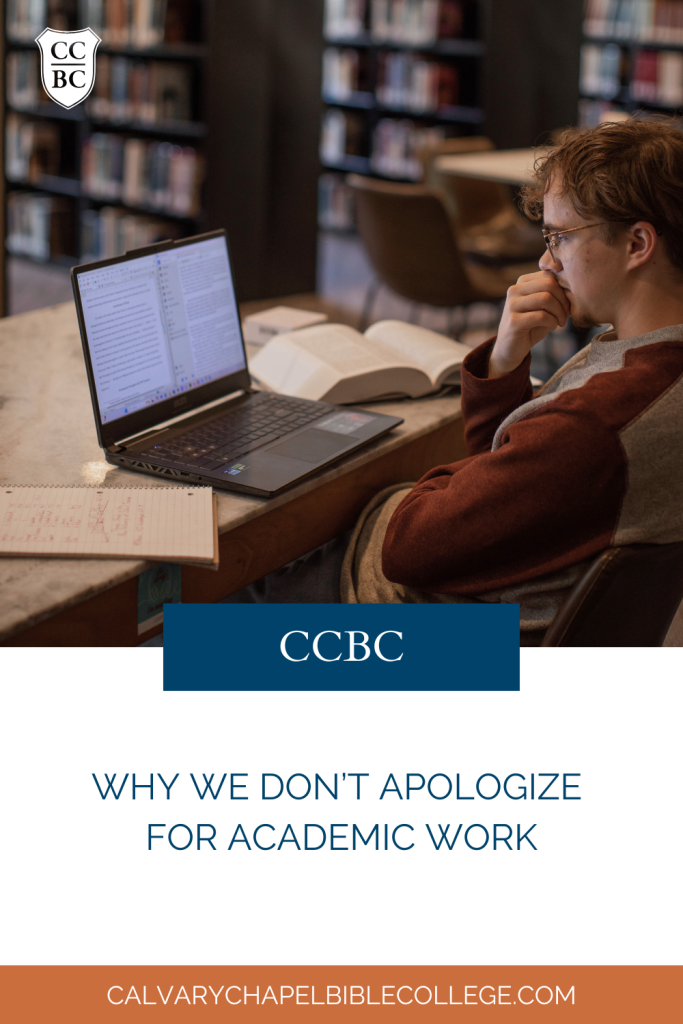

At Calvary Chapel Bible College, we occasionally hear a version of the same concern: “I just want to study the Bible.”
Sometimes that concern is aimed at writing papers. Sometimes it is frustration over reading assignments, discussions, or projects. Sometimes it comes from students preparing for local church ministry who wonder why academic work matters at all. Other times, it grows out of a healthy instinct that grades are not the ultimate goal of Christian education.
In one sense, we agree.
Bible college is not about chasing academic prestige. It is not about intellectual pride. It is not about proving who is smartest in the room. At CCBC, we major in the Scriptures because we believe God has spoken and that His Word shapes every part of life and ministry (2 Timothy 3:16-17). But that is precisely why we take academic work seriously. We want students to study the Scriptures like they matter.
Homework Is Learning
Lectures can be powerful. Sermons can deeply shape a person. Listening matters. Receiving instruction matters. Some truths arrive with tremendous force simply through hearing the Word faithfully taught. But growth is rarely sustained through passive listening alone. Formation happens as truth is wrestled with, practiced, articulated, tested, and applied (James 1:22-25). Homework pushes students beyond merely hearing truth into actively engaging it.
Too often, homework is viewed as little more than a way to measure whether learning happened. A way of proving to a teacher that you paid attention to the lecture, completed the reading, or retained enough information to earn a grade. But Christian education is not simply trying to verify that information entered a student’s brain. Homework is not merely assessment after learning. In many ways, it is part of how learning happens.
The process of wrestling with ideas, organizing thoughts, writing clearly, reading carefully, and reflecting deeply forms students into thoughtful and faithful servants of Christ.
Academic work forms habits that matter far beyond the classroom. Careful reading teaches attention. Research teaches patience. Revising a paper teaches humility. Meeting deadlines teaches discipline. Participating in discussions teaches students how to listen, respond thoughtfully, and sharpen one another.
These habits are not separate from spiritual formation. Much of ministry is ordinary faithfulness practiced consistently over time: preparing sermons week after week, studying Scripture when tired, listening carefully to hurting people, thinking patiently instead of reacting impulsively, remaining teachable. Homework trains students in this kind of steady engagement.
In a culture shaped by distraction and instant reaction, the ability to sit with a text, think deeply, and respond carefully is increasingly rare. Yet these are exactly the kinds of habits that help Christians grow in wisdom and maturity.
Homework Is Practice
Writing is one of the primary ways students learn to think carefully and communicate clearly. Thoughts often feel stronger in our heads than they actually are. Writing exposes gaps in logic, vague assumptions, unclear definitions, and weak reasoning. It forces us to slow down, organize our thoughts, and express ideas coherently.
Ministry requires clarity of thought and clarity of communication. Pastors preach sermons. Counselors offer guidance. Leaders cast vision. Teachers explain truth. Disciple-makers answer questions people are actually asking.
Good writing does not merely display clear thinking. It helps produce it.
The student tracing Paul’s argument through Romans is not just completing an assignment. They are learning how to follow Scripture carefully instead of superficially. The student responding to a theological question is not just filling pages. They are learning how to articulate conviction with precision and humility. These are ministry skills.
Homework trains students to engage carefully, communicate clearly, and handle truth responsibly (2 Timothy 2:15). Like practice in any discipline, it develops capacities that are formed through practice, not merely observation.
Homework Is Formation
We want students to be passionate about Jesus. We want them to love the Church, rely on the Spirit, and answer God’s call wherever He leads. But Christian discipleship involves the whole person. The heart matters deeply. Affection for Christ matters. Worship matters. Dependence on the Spirit matters. But Scripture also calls believers to be transformed by the renewing of their minds (Romans 12:2).
That renewal rarely happens instantly. It usually happens slowly, through repeated practices over time. Through learning to pay attention. Through wrestling with difficult ideas instead of avoiding them. Through learning patience, humility, precision, and discernment. Through learning to think Christianly about God, Scripture, people, and the world.
Homework is not busywork. It is formation. It is discipleship. It is ministry training. That is why we do not apologize for academic work.
At CCBC, we are not simply trying to transfer information. We are seeking to cultivate wisdom, discernment, clarity, maturity, and faithfulness through sustained engagement with Scripture. We want students who do not merely hear the Word, but who have learned to think carefully about it, articulate it clearly, live it faithfully, and teach it to others.
That vision is not new. It reflects the posture of Ezra, who “set his heart to study the Law of the Lord, and to do it and to teach” (Ezra 7:10). That movement from study, to practice, to teaching captures exactly why we value academic work at CCBC. We are not interested in academics for their own sake, but in forming students who know the Word of God deeply, live it faithfully, and are prepared to serve others with wisdom, clarity, and conviction.
Learn more about CCBC